Put the actual serving beside the claim
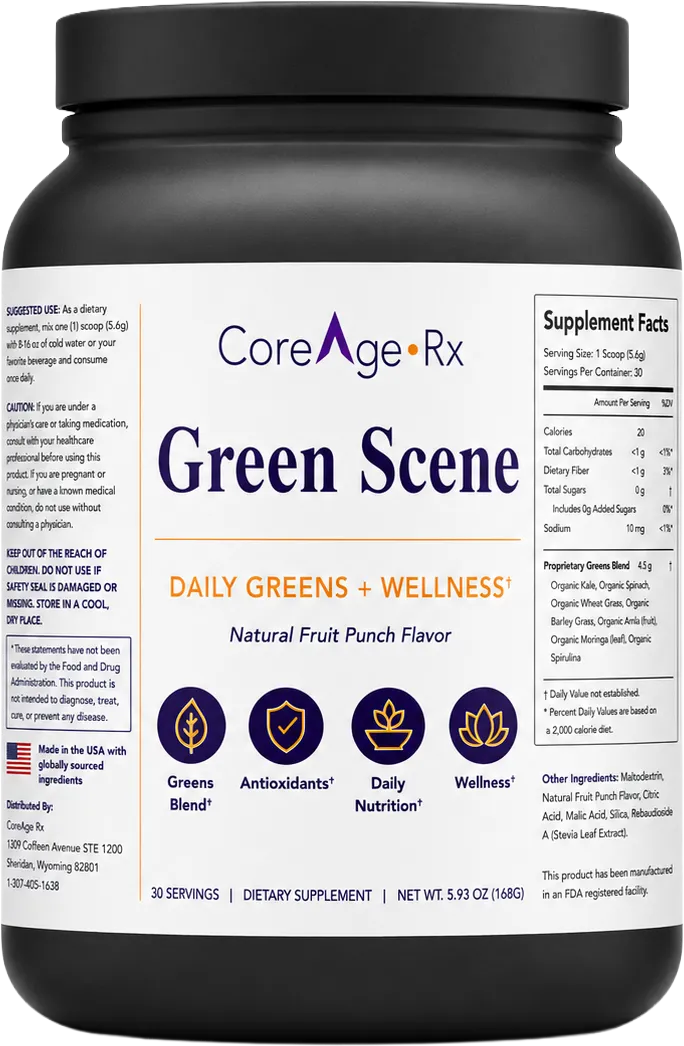
The inspected Green Scene label lists a 5.6g scoop and less than 1g fiber. AG1 Next Gen lists 2g fiber in a 13g scoop. Huel Daily Greens Original lists 1g in an 8.5g scoop. The current Live it Up panel lists 3g in an 8.3g scoop, with separate recall context that must not be overlooked.
These are manufacturer label amounts, not the result of our laboratory testing. They also are not equal-sized servings. A comparison should retain both the scoop size and the fiber amount, rather than selecting whichever denominator makes a preferred product look best. More fiber in one labeled scoop does not establish that it is the right product for a particular person.
FDA's fiber guide explains that fiber occurs in foods including vegetables, fruits, beans and whole grains, and gives a 28g Daily Value based on a 2,000-calorie reference diet. That label reference is not a personalized prescription. It does provide context for recognizing that a small fiber number is only one part of a broader eating pattern.
A blend weight is not a nutrient amount
A proprietary plant blend might weigh several grams without all of those grams being fiber. The ingredient group and the nutrition panel are reporting different information. For Green Scene, for example, the 4.5g blend and the less-than-1g fiber declaration should both remain in the review; one does not replace the other.
Nor does a list of ten plants establish ten useful clinical doses. The amounts may differ substantially, and an extract may not be equivalent to an ordinary serving of the whole food. Without the individual weights and preparation details, a reviewer cannot derive a fair plant-by-plant dose comparison from the names alone.
This matters when marketing cites research about an ingredient. A study of a particular preparation and amount cannot automatically be assigned to a mixture containing an undisclosed amount of that ingredient. The appropriate next question concerns the exact finished product or the missing quantity, not an assumed result.
What would replacement actually need to mean?
A statement such as one scoop equals several cups of vegetables needs a defined basis. Equal in which respect: fiber, a particular vitamin, total mass, or some other measure? A claim with no clear measure cannot establish complete nutritional equivalence. Even matching one nutrient would leave the rest of the comparison unresolved.
The current Live it Up sales page makes a cups-of-vegetables comparison. We report that as marketing, not an independently established exchange rate. Its current label and the seller's prior-formula study qualification are discussed in the full review, alongside the official recall record. A slogan should not displace any of those more specific facts.
For other products, a dense vitamin panel may create a different impression of completeness. Read the amounts and the intended use, but do not infer that high percentages for some nutrients make the product a meal. A fortified supplement and a varied food pattern are not the same decision simply because both can be described using nutrient names.
Convenience is a practical question, not a clinical finding
Some people consider powders because they travel, dislike certain textures or want a repeatable routine. Those are understandable reasons to investigate a product. We have not tested whether the reviewed powders mix easily, taste pleasant or are easier to maintain than another option. Those experiences cannot be invented from a label image.
The buying decision can still be concrete. Consider storage instructions, serving preparation, the complete other-ingredients list and the actual shipment schedule. A product that looks inexpensive per scoop may involve a larger recurring charge or shipping fee. The best-of comparison retains those conditions rather than treating convenience as a proven health benefit.
It is also reasonable to decide that no powder addresses the question you started with. If the concern is a persistent symptom or a suspected deficiency, a product comparison does not establish the cause. A clinician or dietitian can help distinguish the underlying concern from the appeal of a convenient purchase.
Be cautious with detox language
NCCIH describes important evidence limits around detox and cleanse programs. That general guidance is not a trial of these four powders, and we do not use it to claim every greens product has the same risks. It does explain why an undefined promise to remove toxins should not be treated as a demonstrated outcome without a clear substance, measure and study.
Ask what changed, how it was measured and whether the study involved the exact formula. The same habits apply to probiotic claims, covered in our strain-and-count guide. A scientific-sounding ingredient list should lead to more precise questions, not end them.
Finally, keep medicines in the picture. An extra source of vitamins or botanicals is still an exposure to discuss where relevant. Our vitamin K guide describes the warfarin distinction, while the organic-label guide explains why organic wording cannot independently answer suitability. The label can support a careful choice without being asked to prove more than it contains.
Nutrients and tolerance are separate comparisons
If the reason for adding a powder is its vitamin content, the overlap guide shows how to consider other supplements already being used. If the question is digestive comfort, the prebiotic and IBS guide focuses on ingredient identities and missing quantities. Neither a nutrient count nor a gut-health slogan establishes that a scoop can replace the wider contribution of food.